
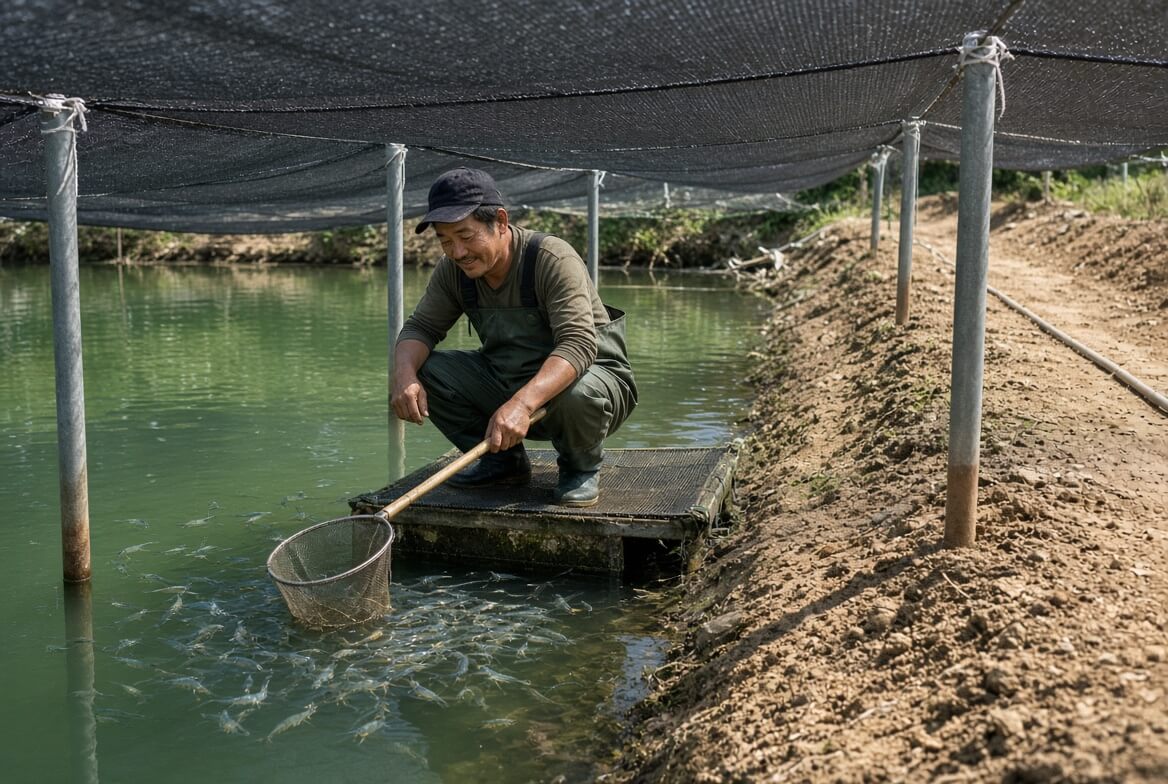
Every summer, prolonged high temperatures pose the greatest challenge to shrimp pond farming. When water temperatures soar above 35℃, shrimp reduce feeding, become less active, and may even suffer mass stress-related deaths. In response to this problem, more and more farmers are installing shade netting over their ponds. This seemingly simple practice is backed by three clear scientific principles.
Solar radiation is the primary source of heat in shrimp pond water. When sunlight penetrates the water surface, the thermal energy it carries is directly converted into internal heat, raising water temperature. Shade netting suspended above the pond acts as a physical barrier.
When sunlight hits the shade netting, most of the solar heat is reflected back into the atmosphere, some is absorbed by the netting material itself, and only a small portion passes through the mesh openings to reach the water surface. Measured data show that shade netting with a shading rate of 60% to 70% can reduce the solar heat reaching the water surface by more than half. This is the fundamental reason why the temperature difference between shaded and unshaded areas of a pond can reach 3 to 5℃.
The core function of shade netting is not to cool the water directly, but to reduce heat input at the source, significantly slowing down the rate at which water temperatures rise.
Shrimp are benthic organisms that naturally inhabit the middle and lower layers of the water column. Intense direct sunlight can make underwater light levels too strong, exceeding the optimal range for shrimp and triggering light stress responses.
Under light stress, shrimp exhibit obvious stress behaviors: avoiding light sources, clinging to pond walls, clustering together, swimming abnormally, and in severe cases, ceasing to feed altogether. When exposed to strong light for extended periods, shrimp consume large amounts of energy just to cope with stress, leaving less energy for growth and molting. This directly undermines farming efficiency.
Shade netting transforms direct sunlight into diffuse scattered light, reducing underwater light intensity from tens of thousands of lux to just a few thousand lux — precisely within the comfortable range for shrimp. Light is no longer a burden, and the shrimp population returns to normal distribution and feeding patterns.
In unshaded shrimp ponds under direct sunlight, heat is distributed extremely unevenly throughout the water body. Surface water absorbs the most heat and its temperature rises rapidly, while deeper water warms much more slowly. This sharp temperature difference creates a stable thermal stratification, where water layers resist mixing and convection.
The surface hot layer continues to heat up while the bottom layer stays relatively cool. If a sudden wind or rainfall occurs, the hot upper water mixes violently with the cold lower water, causing drastic temperature fluctuations throughout the pond. Shrimp are extremely sensitive to sudden temperature changes, and such dramatic shifts often trigger large-scale stress-related deaths.
Shade netting slows down the heating rate of the surface water, reduces the temperature gap between upper and lower layers, and significantly weakens thermal stratification. Even when sudden weather changes occur, temperature shifts during water mixing are much gentler, giving shrimp sufficient time to adapt.
Shade netting does not simply act as a "blanket" for shrimp ponds. Through three mechanisms — blocking thermal radiation, reducing light intensity, and stabilizing water temperature stratification — it creates a stable and controllable living environment for shrimp. For pond management during high-temperature seasons, shade netting has become an indispensable technical measure.


Hello, I am the online customer service

