
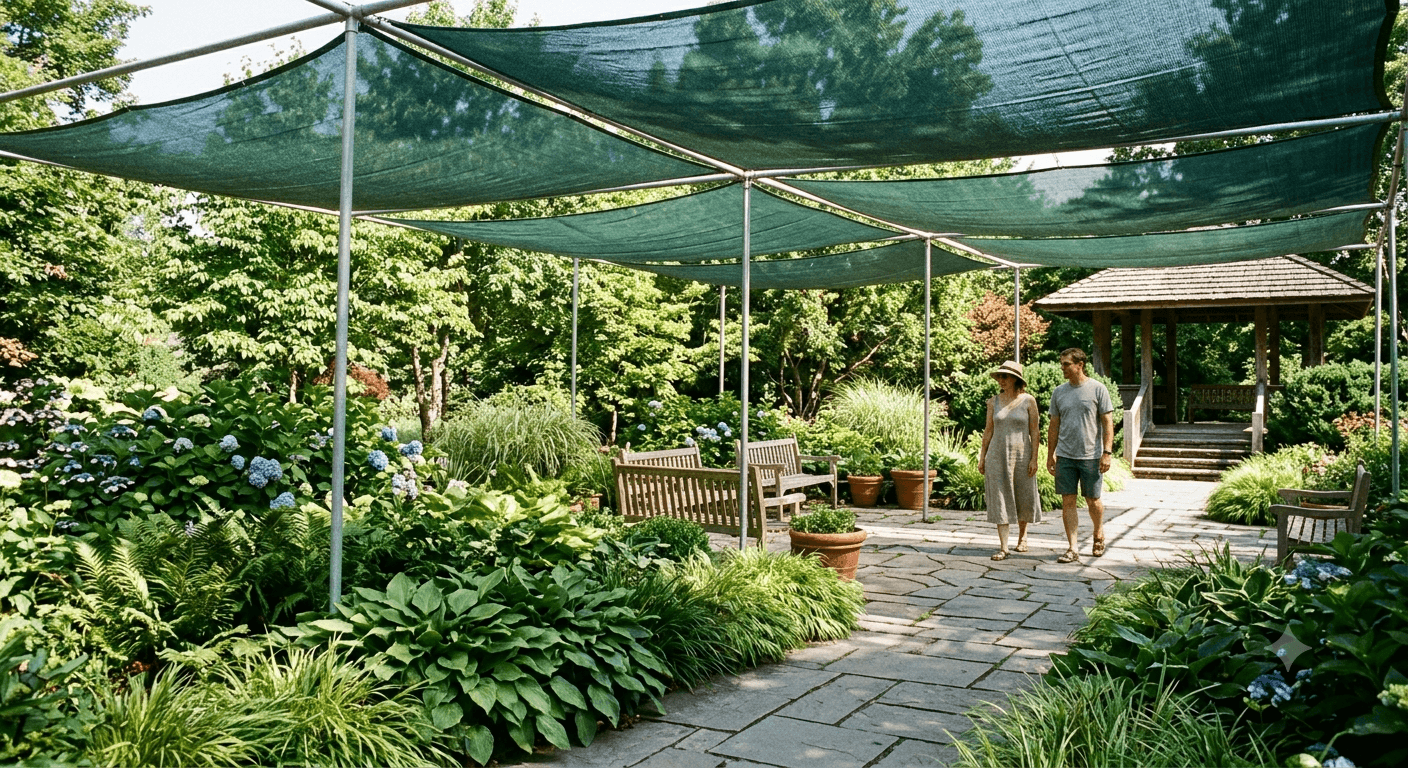
The Ultimate Guide to Garden Shade Netting: Help Your Plants Survive Summer Safely. When scorching sun and relentless heat strike, delicate garden plants face risks of sunscald, wilting, or even death. Shade netting regulates light intensity, lowers ambient temperature, and reduces water transpiration—creating an adjustable "cooling barrier" for your garden. From shade rate selection to installation techniques, this guide helps you tackle summer heat scientifically.
In landscape maintenance, light management is far more nuanced than a simple debate between "too much" and "too little." Different plants have vastly different light requirements—sun-loving roses need ample sunlight to bloom profusely, while shade-tolerant hostas and ferns will suffer from scorched leaves and stunted growth under intense light. The core mission of shade netting lies in precisely matching the optimal light environment for each plant through the scientific selection of products with varying shading rates. A 50%-60% shading rate suits most garden flowers and shrubs, effectively blocking the scorching midday sun while retaining sufficient diffuse light for photosynthesis. For sun-loving vegetables and fruits, a lower shading rate of 30%-40% can be chosen to avoid excessive shading that leads to leggy growth and reduced yields. This "plant-specific" regulation of the light environment establishes shade netting as an indispensable first line of defense in precision landscape maintenance.
Summer heat poses one of the most severe challenges to garden plants. When temperatures soar above 35°C, transpiration in many plants accelerates dramatically, with water loss outpacing root absorption capacity—leading at best to wilting leaves and at worst to complete plant death. Through physical obstruction, shade netting can effectively reduce temperatures beneath the net by 5-10°C, creating a relatively enclosed "air buffer zone" between the net surface and the plant canopy that significantly slows soil moisture evaporation. This dual benefit of cooling and moisture retention is particularly critical for shallow-rooted plants and newly transplanted trees—their fragile root systems have yet to establish deep anchorage, making them most sensitive to drought and heat. Additionally, shade netting buffers the direct impact of heavy rainfall on the ground, dispersing raindrops into fine mist to prevent soil compaction and seedling lodging. On one side of the net lies the blazing sun; on the other, a cool sanctuary where plants thrive undisturbed.
The protective mission of shade netting extends far beyond sun protection. During rain-prone summers, unprotected exposed soil is highly susceptible to erosion from rainfall, leading to topsoil and nutrient loss, while newly sown grass seeds or flower seeds may be scattered and piled up, significantly reducing germination rates. With its dense yet permeable mesh structure, shade netting serves as a "flexible armor"—it disperses and diminishes the kinetic impact of rainstorms, allowing rainwater to infiltrate the soil more gently. For newly transplanted trees, shade netting also effectively reduces direct wind stress, minimizing trunk swaying and helping roots establish faster and more securely with the surrounding soil. Unlike rigid protections such as metal fences or fixed awnings, shade netting's flexible structure avoids friction damage to plants and is less likely to be torn away or destroyed in strong winds, demonstrating unique practical advantages.
Choosing the right shade net is half the battle; using it correctly is the other half. Professional maintenance emphasizes the principle of "elevated installation"—the shade net must maintain a gap of at least 50-60 centimeters above the plant canopy. If placed too close to the foliage, the black netting absorbs heat and creates a "baking effect" that causes secondary damage to the plants. In terms of installation methods, retractable rail-type or roller-blind shade systems are increasingly favored, allowing maintenance personnel to flexibly deploy or retract the net according to daily variations in light intensity—a practice of "weather-responsive management." In material selection, virgin polyethylene (PE) nets with added UV stabilizers can last 3-5 years, far outlasting cheap alternatives made from recycled materials. The correct approach is: determine the shading rate based on plant species, choose the installation method based on site conditions, and select material quality based on expected service life. The maintenance philosophy of "three parts product, seven parts application" is vividly embodied in the selection and use of shade netting.
The value of shade netting is transcending its purely maintenance-oriented function, gradually integrating into the aesthetic expression of landscape design. In contemporary garden design, grey shade netting is no longer viewed as an obtrusive temporary structure but is skillfully transformed into a design element rich with structural interest—its grid-patterned light projections become flowing decorative motifs on the ground, and its soft, breathable texture adds a light, layered dimension to hardscape features. An increasing number of designers are now considering shading systems in concert with overall garden layouts, allowing them to assume aesthetic roles in spatial division and light-and-shadow composition alongside their maintenance functions. From a humble "umbrella" shielding plants from the elements to a "net" weaving seasons throughout the garden, the mission of shade netting in landscape gardening is becoming ever more abundant and profound—it represents both an accommodation to nature and a gentle intervention upon it, embodying the landscape philosophy of "learning from nature while surpassing it."


Hello, I am the online customer service

