
Since 2026, Ukraine has frequently used drones to strike rear-area warehouses, fuel depots, and supply distribution centers deep inside Russian territory. Many of these attacks employ modified commercial quadcopters—costing just a few hundred dollars, highly maneuverable, and yet capable of inflicting considerable damage. A commercial drone that costs a few hundred dollars, with simple modifications, can carry ammunition and accurately hit a target—this is no longer a scene from a war movie, but a reality unfolding every day.
The deeper problem this reality reveals is that the mass proliferation and low cost of drones have made reconnaissance and strike capabilities no longer exclusive to the military. For ordinary civilians, this means that if they find themselves in conflict zones or unstable regions, their homes, vehicles, supply storage points, and even temporary shelters may all fall under the gaze of drones, facing the risk of surveillance or even mistaken targeting.
Civilians cannot equip themselves with electronic jamming devices or air defense systems like the military. A simple, low-cost, and effective solution—camouflage netting—is regaining public attention. It is not a new technology, yet it has found renewed practical value in the face of the novel threat posed by drones.
The effectiveness of camouflage netting relies on the following three mechanisms:
Visual Deception—Making Eyes and Lenses "Missee." Drones typically rely on optical cameras for reconnaissance and target acquisition. The camouflage patterns and colors on the netting break up the otherwise clear outlines of objects, blending them with surrounding fields, forests, grasslands, or building rubble. On a drone operator's screen, a covered house, vehicle, or supply pile no longer appears as a "suspicious target" but rather resembles ordinary ground landscape. On the battlefields of the Russia-Ukraine war, many rear-area depots have reduced their chances of being detected and tagged by drone optics precisely through this method.
Thermal Signature Shielding—Making Thermal Imagers "See Nothing." Many drones are equipped with thermal imagers capable of detecting temperature differences emitted by objects. Human body heat, engine residual heat, and building insulation all appear as bright orange-red hot spots on thermal imaging screens. High-quality camouflage netting, particularly double-layer or multispectral designs, effectively scatters and absorbs infrared radiation from the target, reducing thermal signatures by approximately 75% to 90%. This means that even at night or under low-visibility conditions, thermal imaging devices struggle to identify the specific shape and location of the covered object—a critical advantage against FPV drones equipped with infrared cameras.
Radar Wave Attenuation—Making Radar "Miss." Some military-grade camouflage netting also possesses properties that absorb or scatter radar waves, weakening radar detection capabilities. For ordinary civilians, the first two mechanisms already provide adequate daily protection, with the third serving as an advanced option.
Camouflage netting is not a theoretical concept; it is a measure already validated in actual combat. In early 2026, the U.S. Department of Defense, in its counter-drone guidance document, explicitly listed camouflage netting, protective screens, and other low-cost physical obscuration measures as recommended countermeasures against small drone intrusions, recognizing their effectiveness in compensating for the limitations of active defense systems such as electronic jamming. This document marks the transition of camouflage netting from "military supplies" to officially recognized civilian protection options.
On the actual battlefields of the Russia-Ukraine conflict, both sides have extensively used camouflage netting to protect rear-area ammunition depots, fuel reserves, and maintenance facilities. Ukrainian video footage of successful strikes frequently shows that targets without proper camouflage or with inadequate concealment are the ones that suffer the most. Conversely, facilities covered with camouflage netting and integrated with terrain features often remain difficult to pinpoint even after repeated drone reconnaissance.
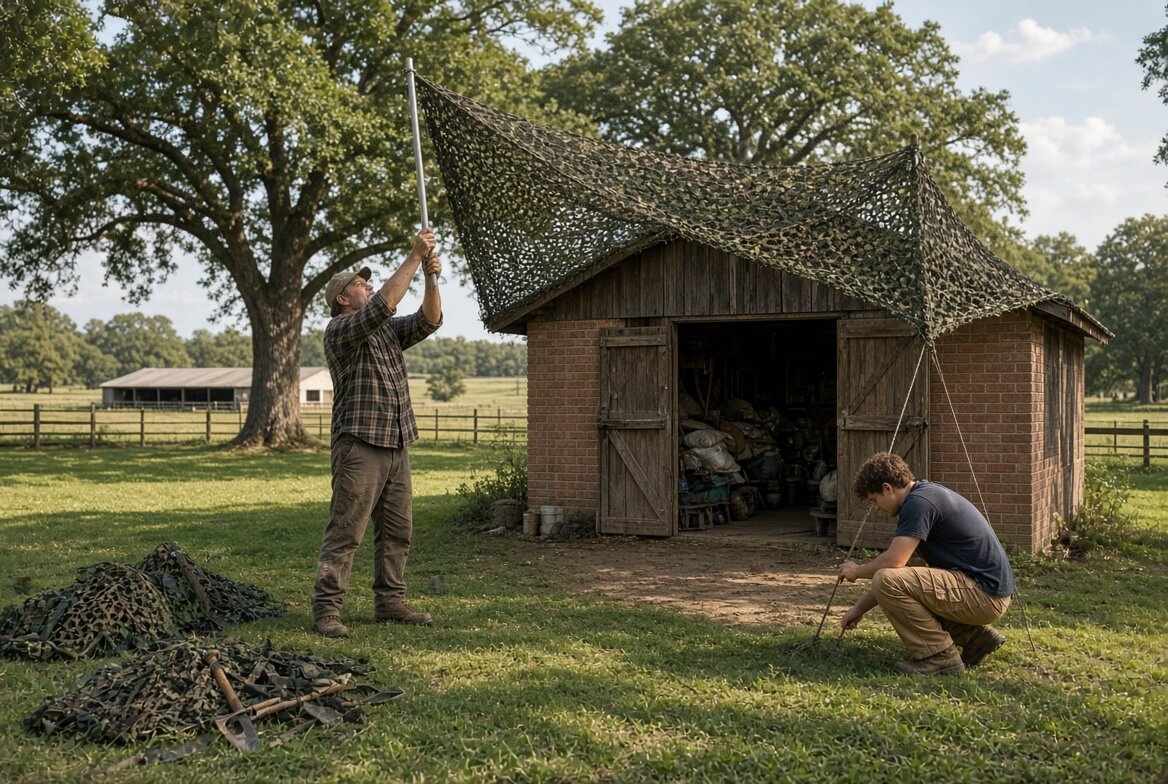
This same logic applies to civilian settings: whether it is rural houses and barns, vehicles and supply stockpiles on the edges of towns, or even temporary shelters erected by urban residents in emergencies, all can gain similar protection through direct coverage with camouflage netting. The survival wisdom from the battlefield can provide the most direct reference for ordinary people's self-protection.
For ordinary people, using camouflage netting is not complicated. The key lies in choosing the right type and applying it correctly.
What to choose? When purchasing, priority should be given to double-layer offset-weave netting with infrared shielding capabilities. The staggered mesh design more effectively refracts light and blocks thermal signatures, offering significantly better protection than ordinary single-layer nets. While single-layer camouflage nets are cheaper, they are mainly effective against the naked eye and are nearly useless against thermal imaging and nighttime reconnaissance. If conditions allow, multispectral camouflage netting is the best choice—it simultaneously addresses optical, infrared, and radar detection.
How to use it? Simply drape it directly over the target you wish to protect. The netting does not need to be taut—a naturally draped or slightly loose coverage actually works better at breaking up the object's outline. For irregularly shaped objects—such as a pile of supplies, a car, or a generator—consider wrapping them first with a tarp or ordinary cover and then applying the camouflage net on top. This not only provides reconnaissance protection but also serves daily weatherproofing needs against rain and sun. If conditions permit, try to choose netting whose colors match the surrounding environment: green tones for fields, sand tones for deserts, and gray-brown tones for urban rubble.
What can be protected? Almost any fixed or movable target—residential roofs, vehicles, motorcycles, supply stockpiles, fuel tanks, generators, temporary tents, and even personal shelters. The key principle is simple: anything you do not want a drone to notice can be covered with camouflage netting.
From the battlefields of the Russia-Ukraine conflict to the daily lives of ordinary civilians, the threat of drones is spreading from the military domain into the civilian world. Faced with this trend, ordinary people need neither feel helpless nor rely on expensive high-tech equipment. A camouflage net—costing just a few hundred dollars, requiring only simple draping—can significantly reduce the probability of being detected and targeted by drones at a critical moment.
Achieving maximum protection at minimum cost—that is the simplest and most genuine value that camouflage netting offers to ordinary people.


Hello, I am the online customer service

