
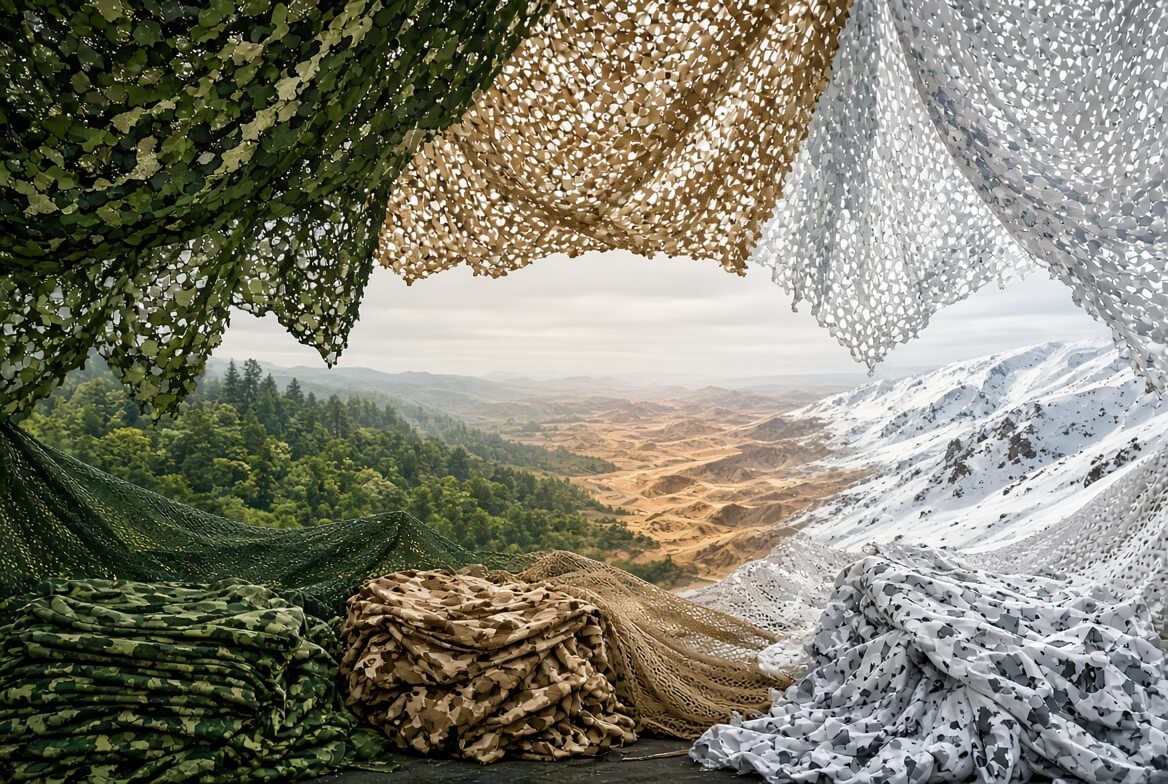
Many people assume a camouflage net is simply a green net thrown over something to hide it. In reality, the color of a camouflage net is never chosen at random. It works more like a terrain "ID card"—the color should match the ground beneath you and the vegetation around you. Choose wrong, and even the best net becomes a target.
Green is the richest category in camouflage nets, but "green" is far from a single color. Deep green matches the shadowed areas beneath dense canopies, light and yellow-green match sunlit young leaves and grass, and brown-green serves the transitional zones of autumn and winter when vegetation thins. Even within the same woodland, the net used in summer and the one used in autumn may be completely different—color choice follows the season: deep and yellow-green for lush spring and summer vegetation, brown-green with earth yellow for leafless autumn and winter.
Even within the same season, different vegetation states call for different treatment—coniferous forests stay deep green year-round, so the net should lean dark and muted; broadleaf forests are translucent light green in spring and summer, so light and yellow-green should carry more weight; low, sparse shrub and grass cover calls for a yellow-green base with deep green accents, avoiding a solid dark green patch that reads as an obvious dark blot. Green is the most complete family precisely because vegetation environments vary the most—one shade of green is simply not enough.
Sand-colored nets are commonly used in deserts, loess plateaus, and arid open terrain, with surfaces composed of light sand, sandy soil, and brown earth tones. But deserts are not only sand. Gobi terrain is scattered with black gravel, where pure sand color would actually stand out, so such nets often incorporate black stone patches and a small amount of deep green. The loess plateau is different again—its surface is a stretch of earth-yellow gullies rather than pale sand dunes, so the net should lean brown and muted rather than toward light sand.
The logic of the yellow family is to match the real color blocks of arid ground, not to assume "a stretch of yellow." In practice, even within a broadly arid region, color should be chosen according to the actual ground at that specific spot: black-stone patches near gravel beds, brown-earth tones near exposed loess.
Pure white nets are used in thick snow cover, with specific requirements for whiteness and reflectance so they blend into snowy backgrounds. The technical difficulty here is not "white" itself but UV reflectance—snow reflects ultraviolet light strongly, and ordinary white cloth tends to look grey against it, so pure white nets require special formulation. But snow is not always pure white. When snow melts, the ground becomes patchy, or when the snow layer is thin and exposes the earth, a white net with earth-yellow patches is needed. The white family has two approaches: pure white for thick snow, white plus earth yellow for patchy snow. Use the wrong one, and pure white becomes the most conspicuous target on the snowfield—a pure white net laid across patchy snow will show its outline more clearly than no cover at all.
Blue ocean-series nets are a relatively special case. In existing products, their described uses lean toward film studios, theme parks, military exhibitions, and outdoor shading, emphasizing visual realism and decorative effect. Strictly from the perspective of military camouflage against reconnaissance, maritime targets have a dynamic sea surface as their background, making camouflage extremely difficult—a single blue net can hardly achieve true concealment. Blue is therefore more of a visual style option, serving display and set design rather than strict tactical equipment. This also reflects an interesting shift: the color logic of camouflage nets is migrating from pure military function toward civilian aesthetics and display needs.
In summary, choosing a camouflage net color is not about "roughly where you are," but about what color the ground beneath your feet and the surrounding vegetation actually are. In broadly wooded terrain, if the hiding spot is near a road with sparse vegetation and earth-yellow ground, the yellowish side should face up. The color code of camouflage nets ultimately comes down to this: terrain determines color, and color determines use. Every color corresponds to a battlefield.


Hello, I am the online customer service

