
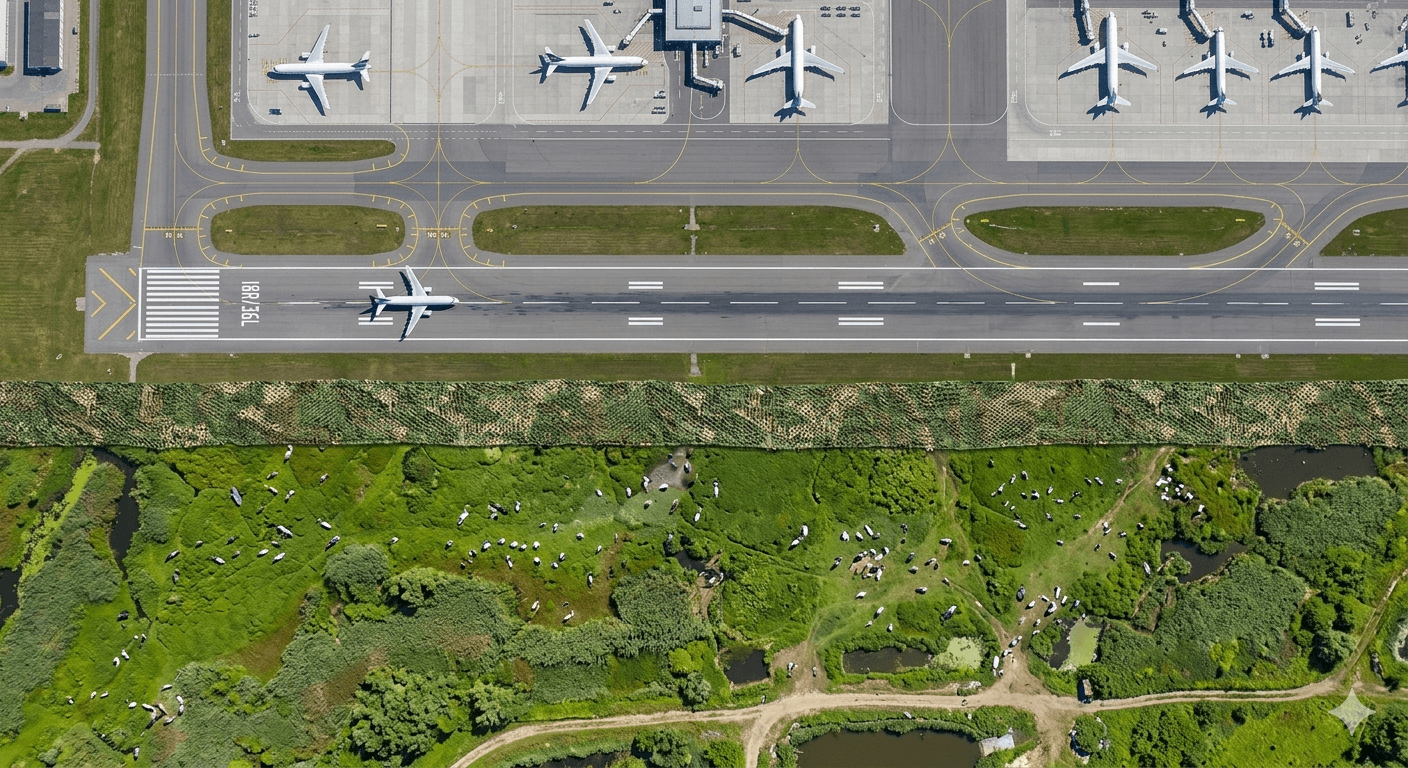
At dawn, as the first rays of sunlight fall upon the airport runway, camouflage nets stand quietly on the grassy edges. Their hues — khaki, olive green, and dark brown — blend seamlessly with the surrounding vegetation, almost imperceptible to the casual eye. These seemingly ordinary nets are quietly playing a vital role as an "ecological buffer zone" between the airport and birds, creating a gentle barrier that balances aviation safety with wildlife protection.
Why do airports attract birds? Expansive lawns, low vegetation, and adjacent wetlands or drainage ponds provide ideal foraging and roosting habitats. However, with aircraft taking off and landing at speeds reaching hundreds of kilometers per hour, a collision with birds — known as a bird strike — can have catastrophic consequences. Bird strikes threaten passenger safety and impose enormous economic losses on the aviation industry. How to ensure flight safety while avoiding harm to birds has become a common challenge for airports worldwide.
Traditional bird deterrent measures — such as firing guns, setting off firecrackers, and deploying scarecrows — often provide only temporary relief, as birds quickly adapt and lose their fear. More troublingly, some places have used fine-mesh, transparent sticky nets, which function as death traps. Birds, unable to see these nearly invisible nets, become entangled and die, including protected species such as the red-footed falcon. Such practices not only violate ecological ethics but have also sparked widespread public reflection.
It is against this backdrop that scientifically designed camouflage nets have gradually gained recognition. Unlike capture nets, these nets are made of thick threads, large openings (typically over 5 centimeters), and natural earth tones, with thread diameters exceeding 2 millimeters — allowing birds to clearly identify them from a distance and actively avoid them. Their core function is not "capture" but "reminder" and "separation" — enabling birds to recognize this boundary and form a cognitive memory that the area is unsuitable for approach, thereby voluntarily steering clear of runway zones.
The true value of camouflage nets lies in their unique ecological wisdom. Unlike cold concrete walls, they are translucent, light-permeable, and responsive to the wind. Sunlight filters through the mesh, grass grows beneath, and insects move freely. For migratory birds, these nets are not an insurmountable barrier but a gentle "speed bump" — they remind birds to adjust their flight altitude and path, yet never trap their wings. During migration seasons, flocks of waterfowl fly calmly overhead — they can see the nets, recognize them, and therefore neither collide with them nor become entangled.
Behind this design lies an upgraded governance philosophy: shifting from "confrontation" to "coexistence." In the past, people habitually relied on "chasing away" and "killing" to solve problems. Today, more recognize that wildlife shares the same skies as humanity, and airport safety cannot be built upon the sacrifice of avian lives. The camouflage net embodies this new philosophy — managing risks with scientific precision and safeguarding boundaries with gentle care.
Of course, even the best tools require human maintenance. Whether a camouflage net is truly safe depends on daily inspections and upkeep. Is the mesh intact? Are the ropes loose? Are edges securely fastened to prevent birds from accidentally getting trapped? These details demand the consistent attention of airport ecological patrol officers. A camouflage net is not a one-time installation but a "living" system that requires ongoing stewardship.
As aircraft thunder down the runway and migratory birds glide in formation across the sky, a camouflage net quietly stands between them. It is neither imposing nor noisy, yet with its soft yet resilient threads, it weaves a green space where airport and nature coexist. Isolation — for runway safety; guardianship — for the freedom of the skies. This is the simplest and most profound meaning of a net.


Hello, I am the online customer service

