
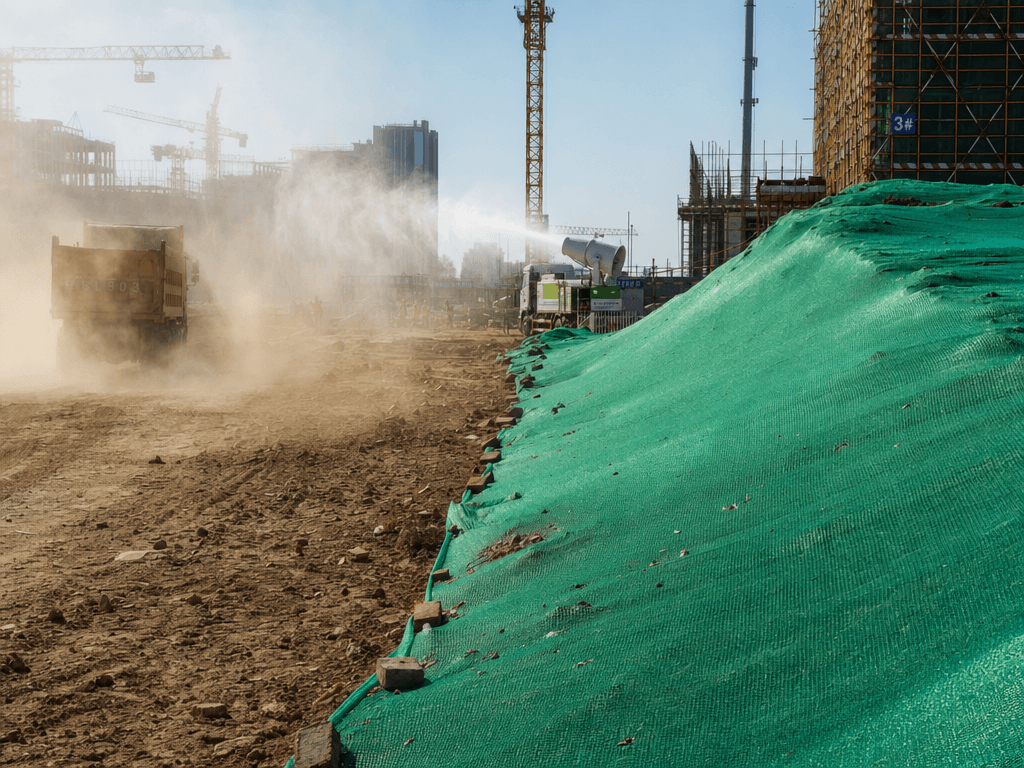
Why do shade nets help control dust at construction sites? If you take a stroll around a construction site, you will often see large piles of soil and areas of exposed ground covered with green netting. Many people assume this is merely for providing shade; however, it serves another crucial purpose: dust control.
Where does construction site dust come from? Primarily, when strong winds blow—or when vehicles pass by—exposed soil, sand, and debris are kicked up into the air, transforming into the airborne particles we know as PM10. To control this fugitive dust, one of the simplest and most effective methods is quite straightforward: "cover the soil." This is precisely where shade nets prove invaluable.
Shade nets are typically woven from materials such as high-density polyethylene and feature a mesh structure with small openings. The principle behind their dust-control mechanism is quite simple: first, they act as a windbreak; second, they provide a physical barrier. When wind encounters the netting, it slows down; no longer possessing the force to lift soil particles, it naturally prevents dust from rising into the air. Furthermore, the netting physically separates the soil from the external environment, ensuring that even when people walk or vehicles drive across the surface, the underlying soil remains undisturbed. Unlike completely impermeable plastic sheeting, shade nets—thanks to their porous structure—allow a small amount of wind to "filter" through the mesh openings. This design makes them far less susceptible to being completely torn away or overturned by strong gusts, thereby giving them superior wind resistance.
Of course, not just any shade net will do. For dust control at construction sites, it is generally recommended to use high-density netting—specifically, a "six-needle" weave or denser—to ensure the mesh openings are sufficiently fine. If the netting is too sparse, it is practically useless. Furthermore, the method of covering requires careful attention: the net must be laid flush against the surface of the soil piles, and its edges must be firmly anchored using bricks, stones, or sandbags. Additionally, adjacent sections of netting must be overlapped; otherwise, the wind will exploit the gaps and slip through. Some construction sites cover their piles so loosely that the netting simply blows away at the slightest breeze—a method that is, quite obviously, completely ineffective.
Finally, it is worth noting that shade netting is not a cure-all solution. It is primarily effective for controlling dust from stationary sources, such as exposed bare ground and stockpiled materials. However, when a site is actively engaged in excavation, truck loading, or backfilling—processes that generate dynamic, airborne dust—netting alone is insufficient. In such instances, it must be used in conjunction with other dust-suppression equipment, such as mist cannons, water trucks, and sprinkler systems.
To summarize: shade netting serves as a low-cost, easy-to-implement, and reusable "blanketing method" for dust control at construction sites. When applied correctly and securely—and combined with other complementary measures—it can significantly reduce airborne dust from the site, offering a solution that is both environmentally friendly and practical.


Hello, I am the online customer service

