
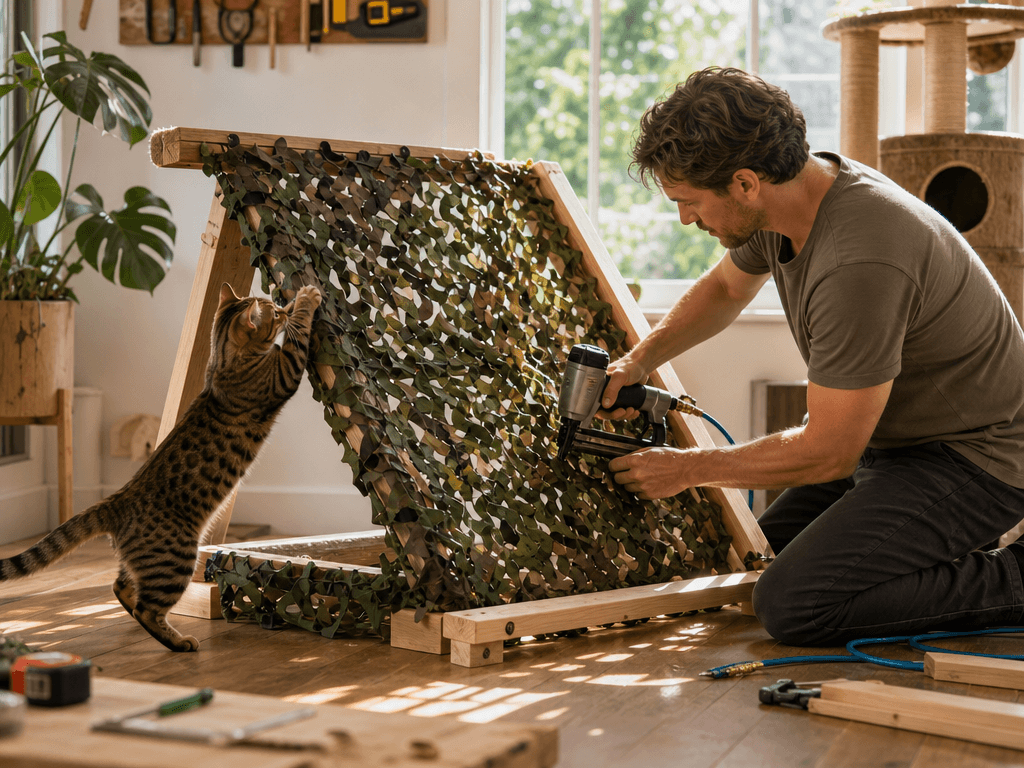
Wood + Camouflage Net: A DIY Cat Climbing Paradise The cat scratching posts we buy for our homes often fray and fall apart within just two weeks; meanwhile, purchasing a large, multi-tiered cat tree can easily cost hundreds—if not thousands—of dollars. However, with nothing more than a jungle-patterned camouflage net (costing a mere ten-odd yuan) and a few pieces of scrap lumber, you can construct a climbing structure for your cat that is both scratch-resistant and incredibly fun.
Pressure-Treated Lumber (3–4 pieces, 2 meters long): Often available in the scrap sections of building supply markets; approx. 15–20 yuan. A 4 cm × 6 cm cross-section is sufficient—no need for anything too thick.
Jungle Camouflage Net: Purchase a 1.5 m × 2 m size online; approx. 12–18 yuan.
Nails or Staple Gun: A few yuan, or simply use old nails you have lying around the house.
Hacksaw and Hammer: Basic tools.
Total Cost: No more than 50 yuan—less than the price of a standard cat scratching post—yet several times more durable.
Step One: Building the Frame.Saw the lumber into four sections: two 80 cm pieces to serve as vertical uprights, two 60 cm pieces to act as horizontal crossbeams, and two additional 50 cm pieces to form the base. There is no need to strive for perfect right angles; simply nail the pieces together casually to form a trapezoidal or A-shaped frame, ensuring only that you leave a flat platform at the very top. In fact, cats often seem to prefer it if the structure is a little bit crooked!
Step Two: Wrapping with Camouflage Netting Unfold the camouflage netting and wrap it around the entire wooden frame, much like wrapping a gift. The netting should be pulled taut, but not stretched so tightly that it loses all give. Secure the edges of the netting by driving nails from the inside of the frame, spacing them approximately every 15 centimeters. Add extra nails at the corners to prevent the cat from pulling the netting loose.
Step Three: Creating Climbing Structures Leveraging the natural drape of the netting, deliberately leave a section of loose, hanging "net curtains" in the center of the frame; cats will instinctively enjoy weaving in and out of these gaps. You can also layer two sheets of netting on the sides to create a sandwiched tunnel passageway. For the top platform, roll up any excess netting to form a padded mat and nail it in place; cats love to lounge in high-up spots.
Key Detail: The coarse nylon texture of the camouflage netting is highly durable and abrasion-resistant. When a cat scratches it, both the sound and tactile sensation closely resemble that of tree bark, and—unlike sisal rope—it is far less prone to fraying or pilling. Furthermore, the open-mesh design allows cats to easily hook their claws into the netting for climbing, making it a friendly and accessible surface for cats of all ages, from kittens to seniors.
The grid structure of the camouflage netting ensures that even after being scratched extensively, it merely develops slightly frayed edges rather than unraveling or shedding threads like fabric—and, crucially, it will not entangle a cat's claws. The more worn and tattered it becomes, the more cats seem to love scratching it.
If the camouflage netting gets torn or worn out after a year or two, simply peel it off and replace it with a new sheet; the sturdy wooden frame will last forever. Replacing the netting essentially gives you a brand-new climbing structure.
The mottled pattern of the camouflage netting creates visual ambiguity that actually stimulates a cat's innate desire to "hunt" and navigate through cover—a behavioral phenomenon known as the "ambiguous stimulus enhancement effect." Cats will repeatedly probe the space behind the netting, finding endless amusement in the process.
Safety Tips: Ensure all nails are driven in from the outside, with no sharp tips left exposed. Widen the base or weigh it down with heavy objects to prevent the structure from tipping over while your cat is climbing. Inspect the netting once a month for any loose threads; simply trim them away if found.
Once this DIY climbing structure is complete, your cat may need a day or two to get accustomed to it. Try rubbing a little catnip onto the netting or tucking a couple of freeze-dried treats into the mesh openings; your cat will quickly realize that this is its very own private jungle. By using a single sheet of camouflage netting, you can replace those disposable cardboard scratching pads—saving money, ensuring durability, and providing your cat with hours of pure enjoyment.


Hello, I am the online customer service

