
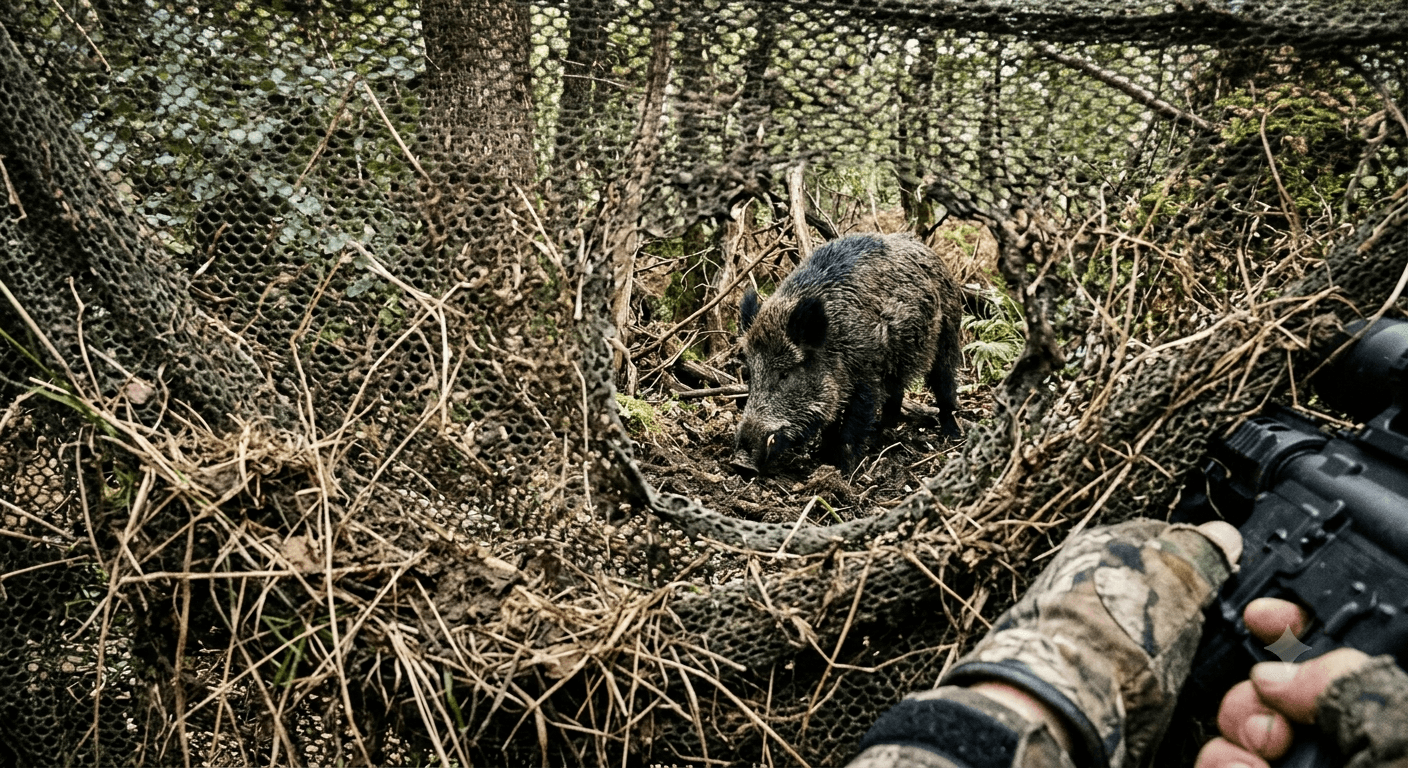
Wild boar—fast, robust, and thick-skinned—are among the most challenging quarry a hunter can pursue. When they feel threatened, they charge without hesitation and fight back fiercely. Though their eyesight and hearing are not as sharp as those of deer, boars possess an extraordinary sensitivity to smell and movement. Any unusual sound or scent can instantly put them on high alert and send them fleeing. To successfully hunt wild boar, a weapon alone is far from enough—a hunter must first master the art of becoming invisible.
Camouflage nets have become indispensable in wild boar hunting because they solve two fundamental problems: breaking outlines and disrupting the human silhouette. Animals' eyes are extremely sensitive to familiar "human shapes"—even if you stand perfectly still, a wild boar may recognize you from a great distance. Camouflage nets, with their irregular patterns and three-dimensional texture, break up and blur the human silhouette, blending it into the surrounding environment. Professional hunting camouflage nets are typically made from polyester oxford fabric and nylon mesh, offering waterproof, mildew-resistant, and corrosion-resistant properties that withstand harsh field conditions.
NBA player Chris Kaman's wild boar hunting experience in Texas offers a vivid demonstration of camouflage in practice. First, he selected two haystacks and strung wire between them, leaving a square opening of about 50 centimeters. Next, he built an alloy frame, reinforced the opening, and reserved shooting ports. Finally, he covered the entire structure with dry hay—from a distance, it looked like nothing more than an ordinary haystack. The finished camouflaged "cave" was spacious enough inside that even Kaman, with his stature, could sit comfortably with room above his head. He was thoroughly satisfied with his creation, confidently declaring: "Under these conditions, it's very easy to hit a wild boar with a pistol!"
Principle One: Break the Outline. The core purpose of camouflage netting is not just to "hide" but to "blend in." Hunters should avoid standing directly behind a tree; instead, position themselves in front of or alongside obstacles, using the net to break the upright "human figure" feature. Sitting is safer than standing—boars are far less likely to recognize a seated human shape and may even walk right past without notice.
Principle Two: Control Your Scent. Boars have a sense of smell far keener than their eyesight. Hunters can bury their camouflage netting in dry dirt and leaves to absorb natural scents, then pair it with hunting-specific scent-masking sprays to significantly reduce the risk of detection.
Principle Three: Choose the Right Position. When hunting in cornfields or thick brush, boars will slowly advance through the final 20 meters before breaking cover, carefully observing and calculating their safe route. Hunters should position themselves behind trees or obstacles to encourage boars to move toward their location—rather than blocking their path directly ahead.
Principle Four: Remain Absolutely Still. Animals are far more sensitive to movement than to color. Once a boar appears in the field of view, any sudden movement by the hunter will instantly give away the position. Only slow, deliberate motions go unnoticed.
When a hunter melts perfectly into the landscape, waiting quietly for the boar to step into optimal range, hunting ceases to be merely about "killing." It becomes a game of wits between hunter and hunted—an intellectual duel played out in nature's arena. Masterful camouflage brings hunters closer to nature, allowing them to merge with it, to feel their heartbeat interweave with the whisper of the wind during the long wait. Beneath the veil of camouflage, the contest between man and boar becomes fair, primal, and pure.


Hello, I am the online customer service

