
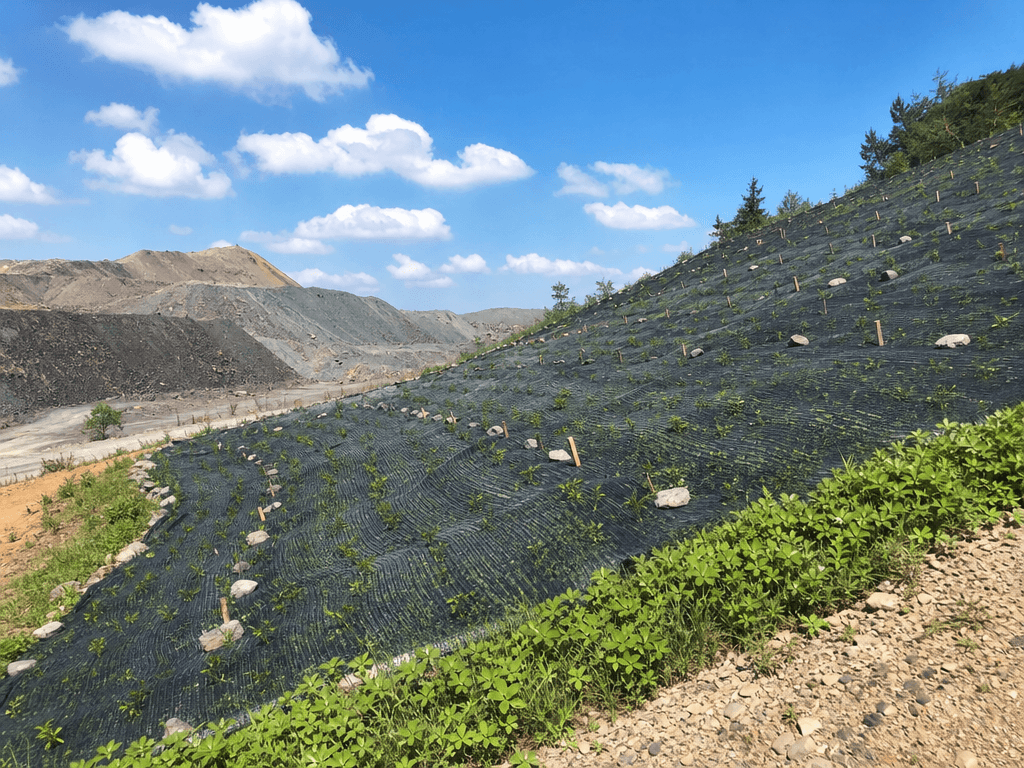
In ecologically fragile zones—such as abandoned mining sites, highway slopes, and desertified lands—facilitating the rapid recovery of vegetation and the re-stabilization of soil has long been a formidable challenge in ecological restoration projects. In recent years, however, a seemingly simple yet remarkably effective tool—the shade net—has found widespread application across various restoration initiatives. Affordable and easy to deploy, these nets play an indispensable role in boosting vegetation survival rates, curbing soil erosion, and ameliorating local microclimates.
The ultimate success or failure of ecological restoration hinges on whether the vegetation can "survive." In arid and semi-arid regions—or in high-altitude environments characterized by intense solar radiation—newly planted saplings and sown grass seeds frequently face two primary threats: excessive moisture evaporation and sunscald damage. Shade nets effectively mitigate direct sunlight exposure, lowering surface temperatures by 3 to 8 degrees Celsius and reducing the rate of soil moisture evaporation by over 30%, thereby buying precious time for the development of plant root systems. Practical experience from numerous restoration projects demonstrates that in areas covered by shade nets, sapling survival rates can increase by 20% to 40%. Furthermore, for shade-loving plants or those particularly vulnerable during their seedling stage, shade nets serve to diffuse intense direct light into softer, scattered light; this prevents leaf scorching and helps young seedlings successfully navigate the most critical and sensitive phase of their early growth.
In areas such as mine spoil dumps and rocky road embankments, exposed topsoil is highly susceptible to erosion by rainwater. When laid over a slope surface, shade nets directly mitigate the splash erosion force of raindrops while simultaneously increasing surface roughness and reducing runoff velocity, thereby effectively minimizing soil loss. In hydroseeding applications, shade nets are frequently used in conjunction with grass seeds, wood fibers, and binders to form a protective "mantle" that prevents seeds from being washed away by rain, thereby providing a stable microenvironment for seed germination and root establishment. Furthermore, shade nets help regulate the local microclimate: they reduce fluctuations in surface temperature within the covered area and stabilize soil moisture levels, fostering the activity of soil microorganisms and the decomposition of organic matter. Concurrently, they moderately suppress the excessive proliferation of light-loving invasive weeds, thereby creating a competitive growth advantage for the target vegetation.
Currently, shade nets are widely utilized in a diverse range of applications, including mine ecological restoration, highway slope revegetation, desertification control, and riparian zone vegetation recovery. Different scenarios impose varying requirements regarding the material and shading rate of the nets: arid regions require a balance between water retention and air permeability, with shading rates ideally maintained between 50% and 70%; high-altitude cold regions necessitate the selection of thicker nets with superior thermal insulation properties; conversely, wetland or riparian restoration projects prioritize the use of biodegradable materials to prevent the subsequent generation of "white pollution" (plastic waste).
The application of shade nets also demands a scientific and standardized approach: a higher shading rate is not invariably better, but rather should be selected judiciously based on the specific plant species and the current stage of restoration; the nets must be securely anchored using wooden stakes, U-shaped pins, or stones; furthermore, priority should be given to biodegradable natural fiber nets, while polyethylene nets—if used—must be promptly retrieved once the vegetation has become established.
Although humble in appearance, shade nets play a pivotal role. At minimal cost and with simple operational procedures, they provide reliable technical support for ecological restoration projects. From barren piles of mine waste transformed into lush, grassy slopes, to dusty road embankments evolving into verdant roadside landscapes, shade nets silently stand guard over the growth of every single seed and seedling. As we advance the ecological development agenda—guided by the philosophy that "lucid waters and lush mountains are invaluable assets"—this seemingly inconspicuous "green net" is emerging as a vital catalyst in the effort to clothe barren mountainsides in greenery.


Hello, I am the online customer service

