
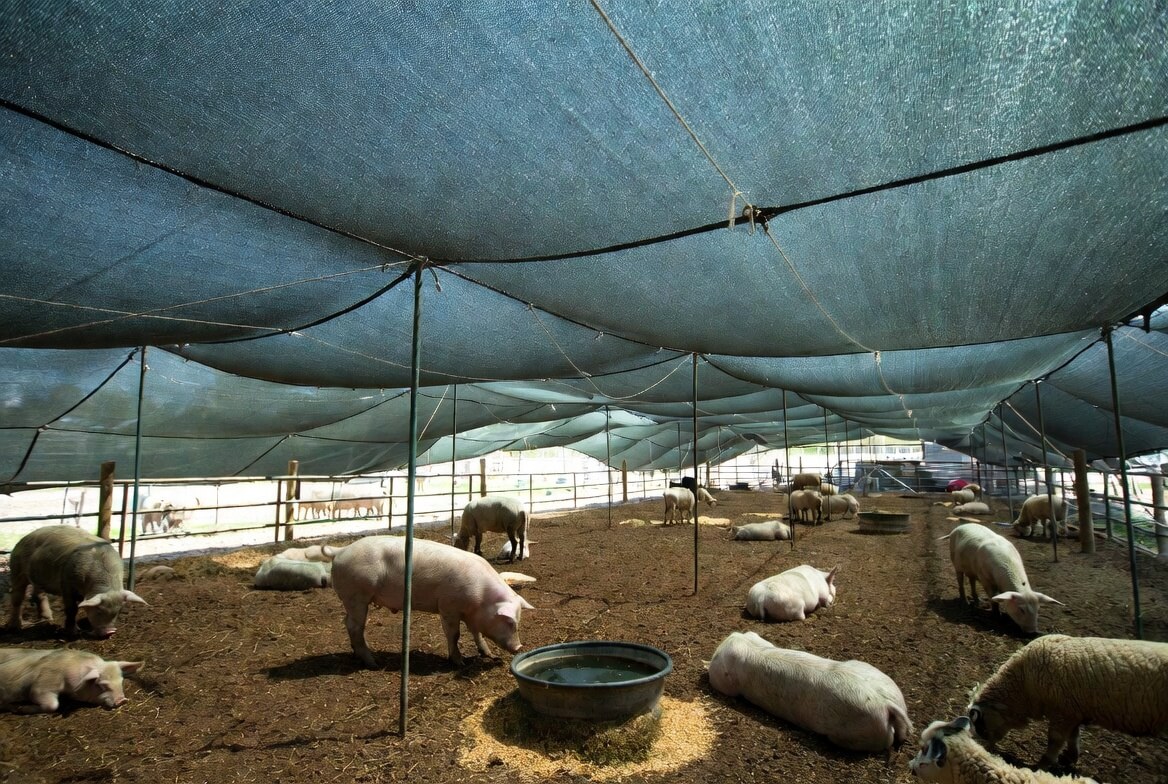
As midsummer arrives with scorching sun and soaring temperatures, livestock farms face enormous challenges. Heat doesn't just make animals restless—it directly attacks the core indicators of farming profitability: feed intake, egg production rate, weight gain, and reproductive performance. At this critical time, a seemingly ordinary shade net becomes a "cool guardian" for chickens, ducks, pigs, sheep, and other animals. It is not high-tech equipment, yet it builds the first line of defense against heat stress on livestock farms in the simplest and most direct way.
For poultry such as chickens and ducks, high temperatures are the number one enemy of productivity. When ambient temperatures exceed the comfort zone, feed intake drops significantly, egg production declines, and eggshell quality becomes fragile and inconsistent. Installing shade nets on outdoor poultry houses or ventilation windows effectively blocks direct sunlight, reduces floor temperatures, and alleviates heat stress on poultry physiology. Practice has shown that in shade-net-covered poultry houses, birds remain more active and eggshell quality becomes more stable—freeing farmers from the anxiety of "summer production slumps."
Pigs are among the most heat-intolerant livestock—they lack sweat glands and cannot cool themselves through perspiration, making them highly susceptible to heatstroke. Under high-temperature conditions, finishing pigs suffer from appetite loss, heavy panting, and stalled weight gain. Sows face even more severe consequences—heat stress can lead to reduced conception rates and even miscarriage. Installing shade nets on pig house roofs or outdoor activity areas can lower indoor temperatures by 3~5°C. This seemingly modest temperature drop effectively restores feed intake and significantly reduces the risk of heatstroke. For pig farmers, shade nets are a "lifeline" that protects both herd health and farming profitability.
Although sheep are generally cold-hardy, hot and humid environments cause them considerable trouble—respiratory diseases become more common, feed intake declines, rumination rhythms are disrupted, and ultimately weight gain suffers. Covering sheep sheds with shade nets creates a cool, well-ventilated microclimate, allowing flocks to ruminate more calmly and convert feed into body weight more efficiently. For dairy cows, shade nets help stabilize milk production during heatwaves and reduce the impact of heat stress on lactation performance. Whether for sheep, beef cattle, or dairy cows, the coolness provided by shade nets is an essential safeguard for a safe and comfortable summer.
Whether shade nets deliver their full value depends on proper selection and installation. Shading rate is the key parameter—for livestock applications, 75%~85% is generally recommended, effectively blocking harsh sunlight while maintaining adequate ventilation and preserving animals' natural biological rhythms. During installation, shade nets should be fixed 30~50 cm above roofs or frames, creating an insulating air layer between the net and the roof surface. Air circulation within this space significantly enhances the cooling effect. Moreover, shade nets are easy to install, cost-effective, and reusable—a "small investment, big return" project that farmers can complete with their own hands.
For chickens, ducks, pigs, and sheep alike, the proper use of shade nets means far more than just "cooling." From a production perspective, it minimizes losses caused by high temperatures—reduced feed intake, declining egg production, and stalled weight gain. From an animal welfare perspective, it provides livestock with a more comfortable living environment, sparing them from heat stress. From a business perspective, shade nets require minimal financial investment while delivering stable production and consistent output throughout the summer—an "economic equation" that livestock farmers can easily calculate. As climate change intensifies and extreme heat becomes more frequent, shade nets are evolving from a "supplementary option" into a "summer standard" shared by both large-scale livestock operations and family farms alike.


Hello, I am the online customer service

