
Originally developed for military use, camouflage netting has long been widely adopted by the film and television industry thanks to its unique ability to provide cover, concealment, and rapid set modification. Far more than mere props for war movies, these nets serve as highly efficient, cost-effective tools for transforming locations and facilitating production. From large-scale battle sequences to outdoor documentary filming, camouflage netting plays an indispensable role on set. This article outlines the five key ways camouflage netting is utilized in film and television production.
In war, espionage, and action-oriented productions, camouflage netting is most commonly used as a key prop to instantly establish an authentic military atmosphere. Production crews drape jungle or desert-patterned netting over military vehicles—such as trucks, tanks, and artillery—or stretch it over trenches, command posts, and encampment tents. The natural drape of the netting, combined with the interplay of light and shadow, allows ordinary locations to quickly take on the visual aesthetic of a frontline position. Compared to traditional set construction, using camouflage netting is not only more economical but also allows for rapid adjustments and dismantling, significantly boosting filming efficiency.
Film and television productions often require transforming modern locations—which lack the necessary period or natural aesthetic—into environments that suit the script. Sites such as abandoned factories, parking lots, and construction zones frequently bear obvious traces of urban infrastructure. Large-scale camouflage netting offers a quick solution to conceal these "anachronistic" elements—such as external air conditioning units, utility poles, and concrete walls. By selecting netting in colors that match the desired setting—such as green, brown, or snow-white—production crews can transform industrial sites into woodlands, mountainous terrain, or deserts within a limited budget. This "netting-as-scenery" approach is particularly well-suited for low-budget productions or crews requiring frequent location changes.
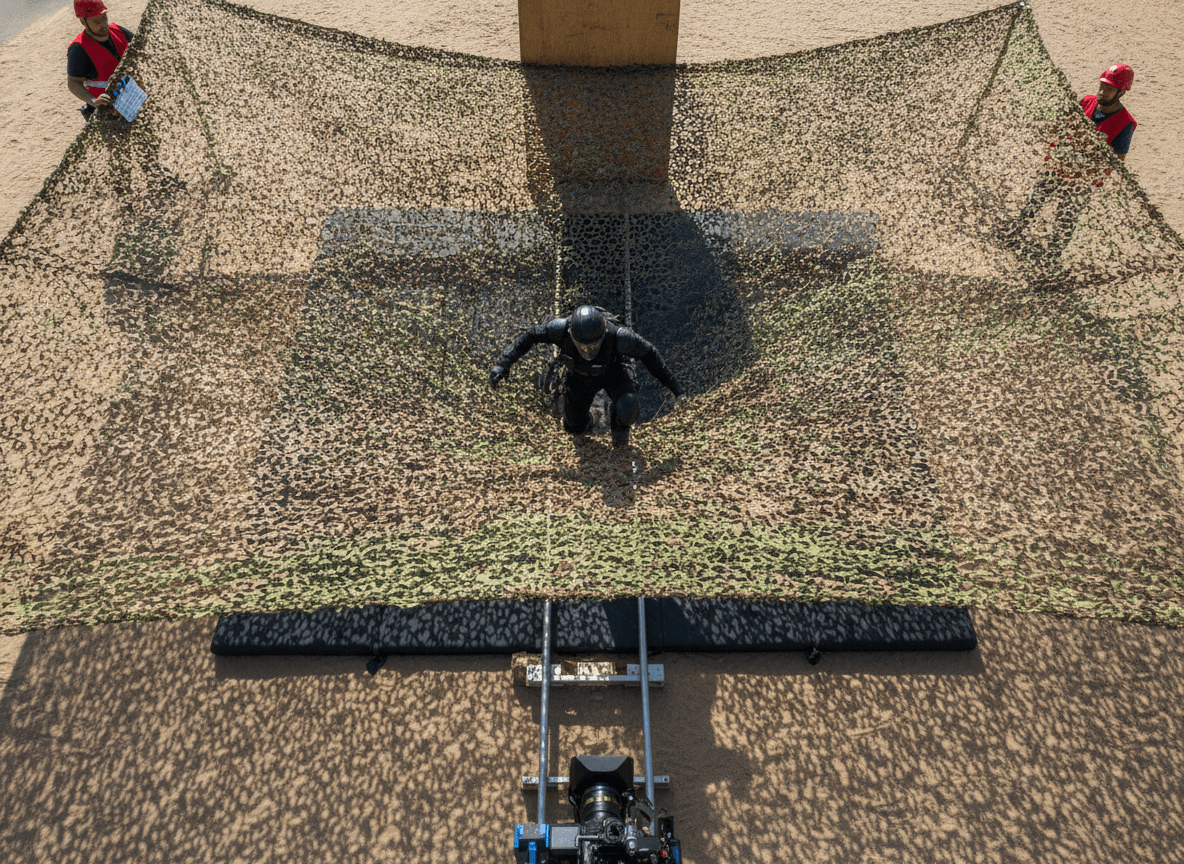
During the filming of action, explosion, or war sequences, stunt performers often execute high-risk maneuvers such as falls, rolls, or being knocked down by shockwaves. Thanks to their flexible and resilient material, camouflage nets are frequently used as the top layer over protective padding. Crews often lay down two or three layers of netting over shock-absorbing mats or foam blocks; this setup provides necessary cushioning while maintaining a realistic ground texture on camera, avoiding the unsightly appearance of obvious safety equipment. Furthermore, the mesh structure of the netting effectively disperses impact forces, thereby reducing the risk of injury. This application makes the filming of high-difficulty stunts safer and more controllable.
When filming wildlife, natural landscapes, or documentaries requiring the observation of subjects in their natural state, the presence of a film crew can significantly disrupt the subjects' natural behavior. Camouflage netting is used to construct concealment blinds or to cover equipment such as cameras, director's monitors, and audio gear. The biomimetic foliage and camouflage patterns on the netting allow the crew to blend into the surrounding environment, minimizing the likelihood of detection by animals or passersby. This method of covert filming ensures the authenticity and natural feel of the footage while demonstrating respect for the subjects.
Outdoor shoots often contend with issues like harsh direct sunlight and excessive contrast between light and shadow. Camouflage netting can serve as a large-scale diffusion screen or sunshade, suspended above the actors or the filming area. Its uniform mesh structure scatters direct sunlight into soft, diffused light, eliminating harsh shadows on faces. Additionally, black or green netting absorbs some light and reduces ambient brightness, making it easier for cinematographers to control exposure. Compared to professional butterfly screens, camouflage netting is more affordable, lighter, and offers better wind resistance, making it particularly suitable for rapid lighting setups by small location crews.
In summary, camouflage netting has far transcended the scope of traditional military gear to become a versatile tool on film and television sets. Whether used to create a battlefield atmosphere, modify locations, protect stunt performers, conceal wildlife filming setups, or control natural light, camouflage netting offers creators an efficient solution thanks to its lightweight nature, rapid deployability, and low cost. As the demand for efficiency and flexibility in film and television production continues to grow, the scope of applications for camouflage netting is set to expand even further.


Hello, I am the online customer service

