
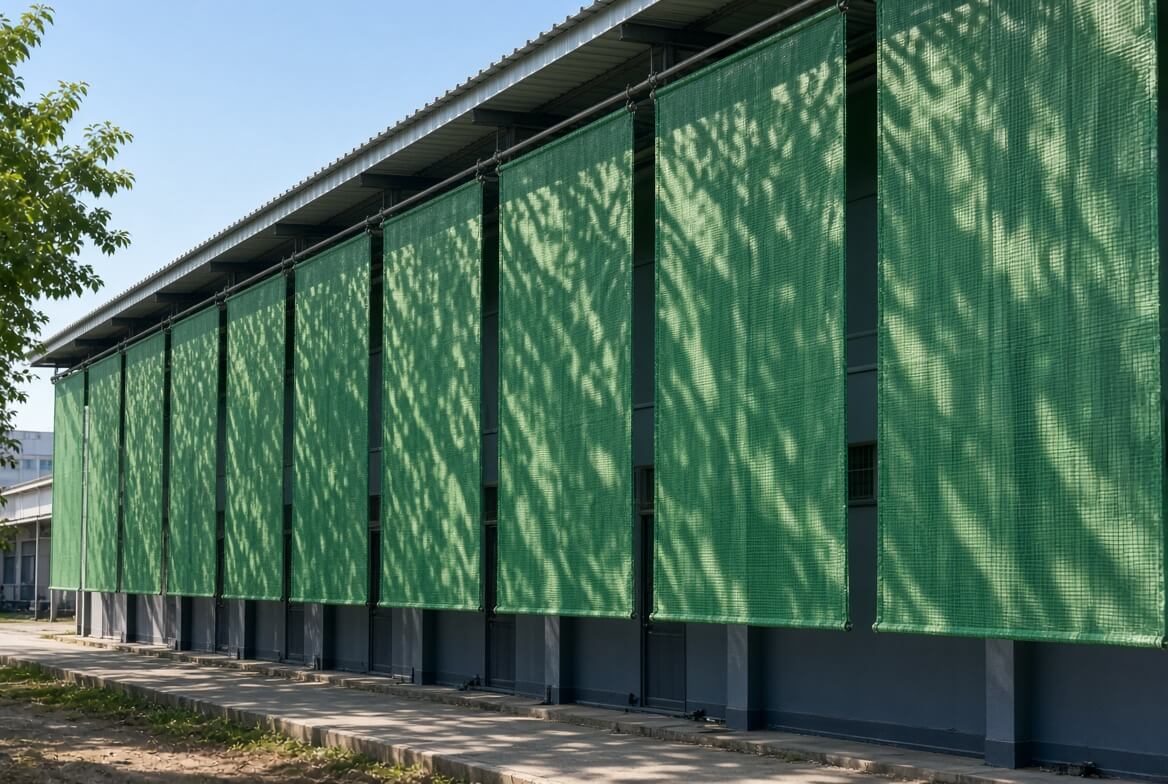
The thermal weakness of a grain warehouse usually lies in its walls. In large flat warehouses, the roof area is extensive while the walls are relatively thin, leaving the structure inherently poor at insulation. Under direct summer sunlight, exterior wall surfaces can easily exceed 50°C. Heat continuously penetrates through the walls into the warehouse, causing both internal temperatures and grain temperatures near the walls to rise rapidly. When grain temperature rises, respiration accelerates, pest reproduction cycles shorten, and mold risk increases—stored grain quality is put at risk.
Rather than waiting for heat to enter and then fighting it with air conditioning, it makes more sense to block it before it gets in. Hanging shade nets on exterior walls does exactly that.
Exterior wall shade net installations in grain warehouses have become fairly mature. Sinograin's Jinxi Direct Warehouse uses custom shade nets made of green high-reflectivity material, covering the southwest wall—the facade with the longest afternoon sun exposure—over an area of about 10,000 square meters. Wuxi Huishan District Grain Warehouse took a similar approach, also hanging about 10,000 square meters of shade nets on exterior walls, conducting multiple experiments beforehand to determine the optimal spacing and coverage method.
Another notable detail is retractability. Jinyun County Grain Reserve Center uses steel wires and sliding buckles to hang shade nets on exterior walls, at a height roughly aligned with the grain stacking line, allowing them to be pulled in when necessary to prevent damage from storms and extreme weather. This design solves a practical problem: fixed shade nets are easily damaged in coastal or windy areas, while retractable designs extend service life.
Temperature reduction data is fairly consistent. Jinxi Direct Warehouse tests showed that when outdoor direct sunlight exceeded 50°C, temperatures inside the shade net could be kept below 40°C. Wuxi Huishan's measurements were nearly identical. Two independent cases yielding similar data suggests this cooling range is reliable.
The direct consequence is less frequent air conditioning activation. Once solar radiation is blocked by the net surface, wall temperature rise is reduced, less heat enters the warehouse, and air conditioning does not need to start as frequently to maintain a quasi-low-temperature environment. For stored grain, this "passive cooling" is more sustainable than simply stacking equipment—it requires no additional energy input and changes the heat transfer path with just a physical barrier.
Shade net applications in grain warehouses are not limited to exterior walls. Research has installed shade nets 70 centimeters above warehouse roofs, combined with natural ventilation and nighttime mechanical ventilation, reducing warehouse temperatures by 2–5°C and upper-layer grain temperatures by 1–3°C.
Guiyang Direct Warehouse's experiment added shade nets to the roof alongside an automatic spray system to further reduce roof temperature. Other warehouses have used shade nets in vent retrofits: in the Yunnan-Guizhou Plateau, strong ultraviolet radiation heats iron ventilation ports under direct sunlight, causing bottom-layer grain temperatures to rebound too quickly. Tests compared three solutions—heat-reflective coatings, reflective insulation cotton, and shade nets—and concluded that all three effectively solved the problem, with shade nets being the lowest-cost option.
Hanging shade nets on grain warehouse exterior walls is not technologically complex, but the logic is clear: solar radiation is the primary external source of warehouse temperature rise. Block this heat pathway, and subsequent temperature control becomes much easier. It does not rely on complex equipment, requires no major investment, is simple to maintain, and can be flexibly retracted according to weather conditions. For stored grain that needs to maintain quasi-low temperatures year-round, this low-cost, low-maintenance physical protection is precisely the most practical choice.


Hello, I am the online customer service

