
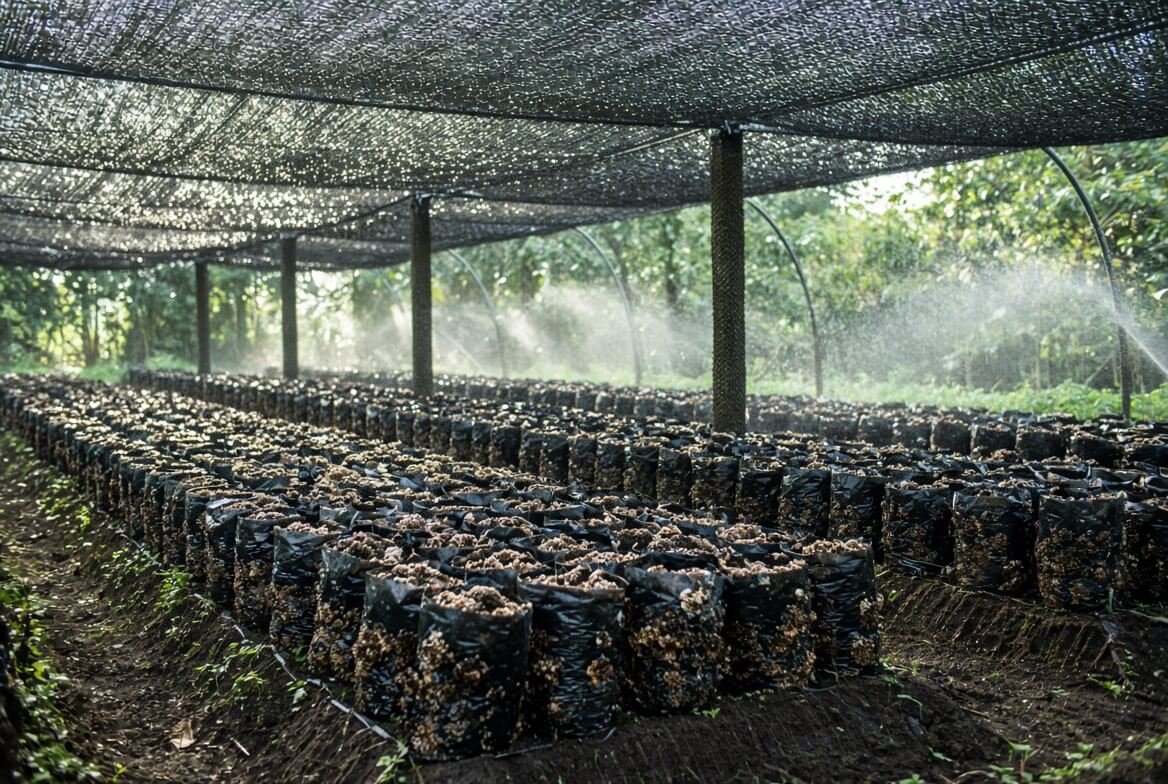
The biggest difference between mushrooms and vegetables is this: mushrooms don't need photosynthesis. When vegetables are covered with shade nets, the goal is to regulate light so crops grow under the right intensity. When shade nets go up in a mushroom shed, the goal is different—it's all about temperature control.
Mycelium is extremely sensitive to heat. Take black fungus: when logs are laid in the field, direct sunlight on a hot day can scorch the mycelium or kill it outright. For shiitake oversummering, if shed temperatures get out of control, entire batches can be lost. The shade net here acts as a heat barrier, blocking solar radiation and keeping the shed within a temperature range the mycelium can tolerate. Understanding this is the key to understanding why shade net use in mushroom cultivation is so particular.
Black fungus logs are typically laid in autumn. There's a risk at this timing: daytime temperatures can still be high, and direct sunlight on the logs can overwhelm the mycelium.
Growers suspend shade nets above the beds. The mesh density is low—not meant to block light completely, but to leave enough room for airflow. The net is elevated at a certain height above ground so air can move underneath and heat doesn't accumulate around the logs. Coverage is concentrated in the first period after logs are laid; once the mycelium stabilizes and ear buds begin to form, adjustments are made based on weather.
The core goals are threefold: cooling, moisture retention, and preventing sunscald. In Aksu, growers add another step—laying straw mats under the nets before covering, which boosts humidity and blocks sediment, protecting ear quality. Moist log surfaces and open airflow beneath the net—this is the ideal microclimate for black fungus in its early field stage.
Shiitake oversummering demands more precision than black fungus. Because shiitake logs are stacked densely inside the shed, heat accumulates more easily, and a single layer of net is often not enough.
In practice, multiple layers of shade nets are stacked with clear gaps between them, allowing heat to dissipate and buffer between layers rather than transferring directly to the roof. The top layer sometimes uses reflective material to bounce more solar radiation back, reducing heat transfer downward. The nets also extend well beyond the shed's edges to form a shade skirt, blocking angled sunlight from the sides.
This system usually works alongside misting. When outside temperatures climb too high, the plastic film is rolled up, misting turns on, and cold water brings temperatures down directly. One critical detail: during misting, inoculation holes face downward to prevent water from pooling at the openings and causing contamination. The shade nets block heat, the misting cools it down—together they keep shed temperatures within safe limits.
The most common mistake in mushroom shade netting is assuming denser is better. In fact, the opposite is true. Black fungus logs in their early field stage actually need low-density nets to maintain airflow and scattered light, avoiding damp, stuffy conditions that breed contaminants. High-density nets have poor breathability; moisture can't escape, and problems follow.
Another easily overlooked point is elevation. Nets pressed directly against the shed surface conduct heat straight through, defeating the purpose. Gaps between layers and space above the roof give heat somewhere to go. The logic boils down to one sentence: the core task of shade nets in mushroom cultivation is temperature control. Match mesh density to the species, leave gaps in the setup, and adjust coverage timing to the growth stage.
From black fungus to shiitake, shade nets in mushroom cultivation are no longer just a simple black net—they are a carefully designed temperature control system. The job they do is far more precise than the word "shade" suggests.


Hello, I am the online customer service

