
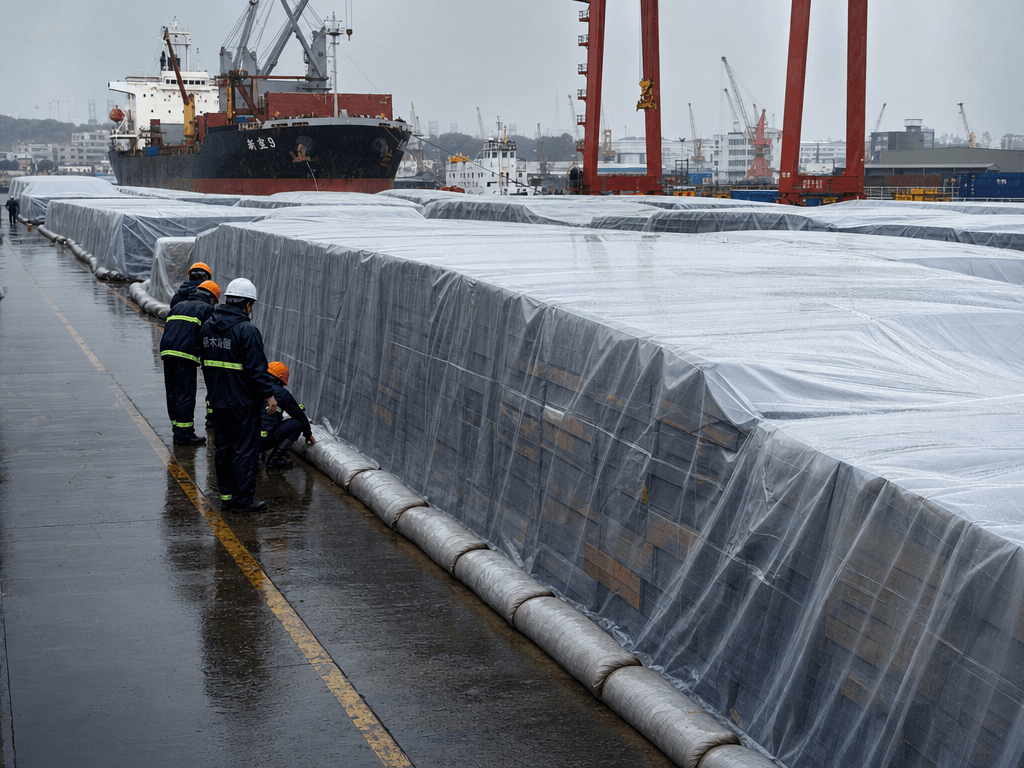
As a critical node in the global logistics chain, docks operate under conditions of high-intensity activity year-round. The vast majority of their storage yards are open-air environments, exposing cargo to an extremely complex array of natural challenges. Salt mist carried by sea breezes, sudden torrential rains, intense ultraviolet radiation, and dust stirred up by port operations can all inflict substantial damage upon stacked cargo. This is particularly true for moisture-sensitive goods—such as wood pulp, fertilizers, grains, and industrial salts—where exposure to dampness can lead to consequences ranging from minor packaging damage and cargo caking to severe dissolution, material loss, or chemical alteration, resulting in direct and significant economic losses.
Furthermore, dock operations are characterized by their round-the-clock nature and high turnover rates; consequently, weather changes are often difficult to predict with precision, leaving extremely limited response time for protective measures during sudden showers or passing typhoons. Thus, establishing a reliable, flexible, and cost-effective on-site protection system has become a central imperative in port operations management. Against this backdrop, tarpaulins—distinguished by their lightweight nature, high efficiency, and reusability—are widely recognized as the preferred solution for protecting cargo in open-air storage yards, playing a vital role throughout the entire process of routine covering, emergency rain protection, and long-term storage preservation.
The fundamental reason why high-quality waterproof tarpaulins play such a pivotal role in dock environments lies in their exceptional physical properties. First and foremost, waterproofing capability is the most basic—and indeed the most critical—performance metric. Professional-grade tarpaulins typically utilize PVC-coated fabrics or polyethylene (PE) materials, boasting a water resistance rating exceeding 2,000 mm of water column pressure. This ensures that even under conditions of continuous heavy rainfall, raindrops are completely blocked from the surface and do not penetrate to the cargo beneath. Secondly, since docks are constantly exposed to intense ultraviolet (UV) radiation, ordinary tarpaulins are prone to aging and becoming brittle; however, tarpaulins infused with UV-resistant additives effectively retard material degradation, providing continuous protection for periods ranging from several months to a full year.
Furthermore, to address the highly corrosive salt-mist environment characteristic of coastal areas, certain specialized coated fabrics feature corrosion-resistant properties, offering an additional layer of protection for metal goods or precision instruments. In practical application, these waterproof tarpaulins serve multiple functions—including dustproofing and wind resistance. When combined with securing measures such as weighted sandbags along the edges and rope lashing, they can withstand gusting winds of Force 6 to 7, thereby preventing the tarpaulin from being dislodged and leaving the cargo exposed. It is precisely this comprehensive suite of performance capabilities that elevates the waterproof tarpaulin beyond the role of a mere covering, transforming it into a complete, "mobile warehouse enclosure system."
At the practical operational level, terminals have established a mature and highly efficient set of protocols centered around the use of waterproof tarpaulins. Taking sudden rainfall as an example, ports commonly adopt an "on-the-fly covering" emergency mode: when weather radar indicates an approaching rain front, on-site workers can complete the rapid covering of critical cargo stacks within five minutes, ensuring a seamless transition between cargo handling operations and rain protection measures. For large-volume, regularly shaped cargo (such as cold-rolled steel coils or pulp bales), some ports have innovatively adopted specialized, three-dimensional fitted covers. Resembling large rain hoods, these covers can be lowered over the cargo in a single motion from the top down, with drawstrings used to cinch the bottom edges; this method offers wind resistance and sealing capabilities far superior to traditional flat-sheet covering techniques.
For cargo requiring long-term storage, a multi-layer composite covering method is employed: a waterproof ground sheet is laid at the base to isolate the cargo from surface water; a primary waterproof tarpaulin covers the middle layer; and an additional layer of old canvas or protective netting is placed on top to mitigate UV-induced aging, while the perimeter is secured section-by-section using sandbags or specialized weights. These practices have not only drastically reduced the rate of moisture-related cargo damage but have also minimized efficiency losses caused by weather-induced operational stoppages. According to statistics, the implementation of standardized waterproof covering protocols has led to a reduction of over 80% in cargo damage compensation claims during the rainy season, alongside a significant improvement in customer satisfaction.


Hello, I am the online customer service

